Transform your document digitization with Intelligent Document Processing (IDP) Solutions that meet federal standards for quality and efficiency.
Smart FADGI-Compliant Solutions for Archiving Digital Documents
Transform your document digitization with Intelligent Document Processing (IDP) Solutions that meet federal standards for quality and efficiency.
What is the Federal Agencies Digital Guidelines Initiative (FADGI)?
As government agencies transition to an increasingly paperless environment, the federal government must ensure that all preserved files are held to a uniform standard. This is where the Federal Agencies Digital Guidelines Initiative (FADGI) comes in.
FADGI is a common set of technical guidelines, methods, and practices for the proper archival of digitized and born-digital documents. These standards provide a framework for creating high-quality digital images that can be reliably preserved and accessed for years to come.
Why is FADGI Compliance So Important?
Following the U.S. government’s initiative called M-19-21 and later updated as M-23-07, the federal government has now mandated FADGI compliance for all organizations working with federal agencies. The primary goal is to stop the flow of analog materials into the National Archives in favor of electronic records.
But FADGI compliance offers benefits beyond meeting regulatory requirements. Following FADGI standards for image quality ensures the digital images you produce meet a quality standard that is ideal for long-term archival. These high-quality images are also more reliable for data extraction, resulting in higher data accuracy and fewer errors downstream.
While FADGI compliance is mandatory for federal agencies sending records to the National Archives, any organization can now implement these same standards easily with ibml’s digitization technology.
Explore ibml Government Solutions: Document Processing for Federal Government Agencies | ibml
Why Traditional Digital Archiving Methods are Holding You Back
Organizations attempting to meet FADGI standards with conventional approaches face significant obstacles:
- Inferior Image Quality
Standard scanners often fail to capture the level of detail required for three-star FADGI certification, leading to rejected batches and rework. - Processing Bottlenecks
Manual verification processes create delays, preventing organizations from meeting deadlines and slowing digital transformation initiatives. - Slow Scanning Speed
Traditional equipment lacks the throughput necessary to handle large-scale digitization projects efficiently, extending timelines and increasing costs. - Lack of Proper Infrastructure
Without integrated verification tools and automated audit trails, maintaining compliance becomes a labor-intensive, error-prone process.
How Can Your Organization Comply with FADGI?
To properly comply with FADGI standards, organizations must ensure captured images meet a minimum of FADGI three-star quality.
Understanding the FADGI Quality Rating System
The FADGI evaluation system defines four image quality levels from one star to four stars, with higher star ratings correlating to higher image quality and applicability for different use cases. Each level has specific technical requirements for resolution, tonal response, and color accuracy.
The three-star level represents the threshold for federal compliance and is suitable for most archival and records management applications. This level balances high image quality with practical processing speeds, making it the target standard for most organizations.
Download the Whitepaper: The ibml FADGI Reference Guide | https://www.ibml.com/
Why Choose ibml?
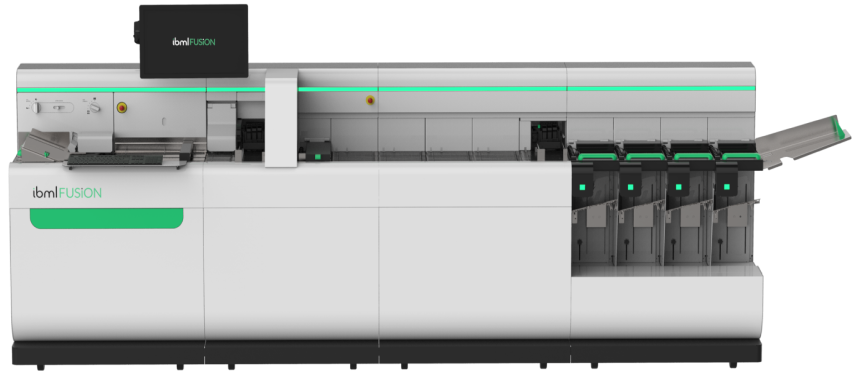
ibml offers the only FADGI three-star compliant high-speed scanner on the market, designed with patented hardware and software-based technology, making your FADGI compliance workflows fast and easy.
4 Benefits of ibml’s FADGI-Compliant Solutions
- Faster Preparation
Streamlined workflows reduce document preparation time, getting your materials ready for scanning more quickly. - Accelerated Throughput
Industry-leading scanning speeds that do not slow down for FADGI compliance mean you can process more documents in less time without sacrificing quality. - Ease of Operation
Intuitive interfaces and automated processes minimize training requirements and reduce operator error. - Reliable Auditing
Automated audit trails ensure complete documentation of your compliance processes, simplifying verification and reporting.
How to Solve FADGI Compliance with ibml
Certified High-Speed Hardware
ibml Fusion HD Scanner
- High Speeds: 321–474 pages per minute (PPM)
- Guaranteed Three-Star Quality: At up to 400 dpi reference resolution
- Built for Compliance: Patented hardware ensures consistent, certified image quality
Learn More: High-Speed FADGI-Compliant Scanners: ibml Fusion HD
Certified High-Speed Software: FADGI Verification Module
- Streamlined Image Verification: Automated quality checks eliminate manual review bottlenecks
- Automated Audit Trails: Complete documentation generated automatically for compliance reporting
Running at industry-best speeds of up to 474 PPM, the ibml Fusion HD scanner can generate FADGI-certified images with a three-star rating at 300 dpi reference. Pairing the ibml Fusion HD with our proprietary ibml FADGI Verification Software Module allows you to go one step further by simplifying the verification process into one seamless workflow and offering automated audit trails, saving you time and money.
Frequently Asked Questions
What does FADGI stand for, and who created it?
Is FADGI compliance mandatory for all organizations?
What’s the difference between FADGI’s one-star, two-star, three-star, and four-star ratings?
How long does it take to achieve FADGI compliance with ibml solutions?
Can existing scanners be upgraded to meet FADGI standards?
What types of documents can be scanned with FADGI-compliant equipment?
How does automated audit trail generation work?
What resolution (DPI) is required for FADGI three-star compliance?
How much training is required to operate ibml’s FADGI-compliant equipment?
What ongoing maintenance is required to maintain FADGI certification?
From Compliant Images to Actionable Data with ibml Coretex
FADGI-compliant scanning ensures your digitized documents meet the highest image quality standards. ibml Coretex ensures intelligence is captured from those images automatically, classifying every document type, extracting key metadata fields, and organizing records for downstream systems without manual indexing.
For agencies managing large-scale digitization mandates, Coretex’s fully on-premise deployment means sensitive records and AI training data never leave your secure environment.
Ready to Achieve FADGI Compliance?
Discover how ibml’s IDP solutions can streamline your digital archiving workflows while meeting federal standards. Request a demo today and learn how we can help your organization achieve three-star FADGI compliance efficiently and cost-effectively.